- Honeyberry, a.k.a. "Blue Honeysuckle"
- Goumi - I have a friend in the neighborhood who grows these and they seem to do okay, especially the part of the bush that gets more sunlight. But the fruit production is only so-so. The flavor reminded me of pie cherries (sometimes called "sour" cherries). I really like that goumis are nitrogen fixers, too.
- Jostaberry - hybrid of gooseberry and black currant
- Black raspberry, purple raspberry, yellow raspberry - I just want to add more colors and try the different flavors
- Shipova - hybrid of mountain ash and pear
- Black apricot - naturally occurring hybrid of Prunus armeniaca and P. cerasifera
- Peacotum - hybrid of peach, apricot and plum
- Paw paw - produces the largest edible fruit native to America, plus some say the fruit tastes like vanilla custard. Yeah, I want one... or maybe two.
- Persimmon - I want to really try to promote native American fruit,
- Mulberry - I grew up with a mulberry tree and I really enjoyed them. And maybe it will keep the birds out of the cherries.
- Pomegranate (in a pot) - exotic plant that would heighten my hard core grower status just by having one. Actually getting fruit from it would just be gravy. Sweet, delicious gravy.
- Jujubes - I think that name just sounds cool, which is enough for me to want to grow the tree. Add on the fact that it produces edible fruit and I'm convinced. It needs hot summers to ripen which makes me wonder why it is not regularly grown here because it has been plenty hot.
- Maypop - native to the eastern U.S., it is a passionfruit vine that dies back in the winter and pops out of the ground in may. The flowers are exquisite and exotic. Plus, I want to eat my own passionfruit.
- Almond - my favorite nut might taste even better if I could grow my own
- Yellowhorn - nitrogen-fixer that produces small nuts. Another nut tree that does not take up most of the yard.
- Bamboo (specifically Phyllostachys nuda) - building material, edible, just plain neat.
- Blood orange (in a pot) - some of the best tasting fruit that I have ever eaten. With this and the pomegranate I could really get started on my indoor orchard.
- Prickly pear - I know it grows wild in much of the western U.S., but I have seen and tasted how much better the fruit is when it gets a modicum of attention. And the results were delicious.
Showing posts with label plants. Show all posts
Showing posts with label plants. Show all posts
Thursday, July 4, 2013
Wish List Plants
I love looking at One Green World and Raintree Nursery catalogs, going through the large selections of all kinds of plants, but most especially the perennial fruiting plants. It is almost the same as going through the Christmas catalogs when I was a kid, the only difference is that I might actually get some of the plants. Anyway, the result of the plant ogling is that I have created a list of plants that I really want to try growing in this area and finagle into doing my bidding (mwah hah hah), i.e. grow tasty fruit that makes my belly happy.

Tuesday, May 21, 2013
Specimen Spotlight: Serviceberry
Serviceberry (Amelanchier spp.)
Serviceberries provide a nice snack while hiking in the mountains around here where they grow natively. Many people probably have not even thought about the potential gained by including serviceberries in the yard. They start small but can grow into small trees if left to themselves. Here are the other things that I have learned about serviceberries.
 |
| Saskatoon berries and foliage - Source |
- The fruits, when ripe, are dark purple with a bluish bloom on them that children like to meticulously rub off as a means of entertainment prior to eating. Not that the bloom affects flavor in any way. It is just something that I have noticed many children doing. :-)
- The birds and other animals like the berries, too. The birds seem to leave them alone until late in winter when other food sources are gone. I don't know if this is because they really do not like them or if the birds know that the berries, albeit somewhat withered, will store on the plant until needed.
- On that note, the fruit still tastes really good when it ripened fully and then slowly dried out on the branch. In our climate at least, the serviceberry fruit does not go bad when left unpicked. It just dries up, condensing its flavor and sweetness in a pleasant way.
- The fruit tastes best when the plant has had plenty of moisture, but the plant can handle drought pretty well when it is well established.
- In the spring, around April or early May, the plants will put on white blossoms that are a great early food source for any insects that may be out looking for a meal.
- It likes full sun, but I have seen it growing just fine in dappled shade.
- Pioneers used serviceberries in pies and jam. Native Americans ate them raw, dried like raisins, or as part of their pemmican. Everybody of that time ate them when they had them.
- The hard serviceberry wood was used almost universally, according to the book Wild Berries of the West
, to make arrows, spears, and a myriad of other items.
- The fruit can be used to make a purple dye.
- It provides bird habitat and, if you are willing to share, food.
- It fits the shrub niche nicely when trying to determine what plants to add to a plant guild.
- Chicken friendly!
References
- Sepp Holzer's Permaculture: A Practical Guide to Small-Scale, Integrative Farming and Gardening
, pg. 91, 107
- The Forager's Harvest: A Guide to Identifying, Harvesting, and Preparing Edible Wild Plants
, pg. 207-213
- Edible Wild Plants: A North American Field Guide to Over 200 Natural Foods
, pg. 206-207
- The Permaculture Handbook: Garden Farming for Town and Country
, pg. 329
- Wild Berries of the West
- The Backyard Homestead: Produce all the food you need on just a quarter acre!
, pg. 116, 120
- Gaia's Garden, Second Edition: A Guide To Home-Scale Permaculture
, pg. 164, 165, 169, 198-200, 218, 221
- Free-Range Chicken Gardens: How to Create a Beautiful, Chicken-Friendly Yard
, pg. 55, 132
Friday, May 17, 2013
Specimen Spotlight: Rhubarb
Rhubarb (Rheum x cultorum)
Rhubarb used to be ubiquitous in backyards across America, providing one part of the strawberry-rhubarb combo used in jams and pie. It is an easy-to-grow perennial that also functions as an ornamental with very large green leaves on long stalks. It is beneficial for more than just making it so one can make great pie. I have listed below a few other roles for rhubarb.
Rhubarb used to be ubiquitous in backyards across America, providing one part of the strawberry-rhubarb combo used in jams and pie. It is an easy-to-grow perennial that also functions as an ornamental with very large green leaves on long stalks. It is beneficial for more than just making it so one can make great pie. I have listed below a few other roles for rhubarb.
- Edible - stick with the stalks, the rest should be considered poisonous

Rhubarb with flower stalks - Fodder - unlike humans, chickens can eat the leaves with impunity, and love to do so
- Mulch maker - the huge, soft leaves are great for outdoor carpets
- Perennial - one of the first plants up in the spring in my yard
- Insectary - sometimes you end up with a female plant that puts up flower stalks. These stalks are pretty tall and are covered with flowers that insects love.
- Partial shade to full sun - more likely to be tolerant of some shade when it has the springtime to wake up and grow before being overshadowed by a tree or other deciduous perennial.
- Propagate by clump division
- Medicinal - especially the root

Friday, May 10, 2013
Plant Roles: Nutrient Accumulator
Some plants have the ability to put down deep roots and pull up nutrients into their leaves. These leaves then return the nutrients to the topsoil when they die and decompose, at which point the nutrients are freely available to other plants. Because of their ability to do this, these plants are called nutrient accumulators, accumulating specific nutrients and then releasing them upon decomposition.
Nutrient accumulators are an important facet of a self-fertilizing garden. Necessary nutrients that are missing from the topsoil can be collected and shared out. The nice thing is that these plants' natural abilities and tendencies do all of the work. Many of these plants focus on specific nutrients, so, by determining which nutrients are missing you can determine which plants to add. Once added, these plants will begin to mine for the critical nutrients.
Toby Hemenway, in his book Gaia's Garden, has a list of eighty-four plants that are nutrient accumulators for
one or more of a dozen different nutrients. Some are typically considered weeds, such as dandelion, Lamb's quarters, and red root pigweed. Others are well known herbs, like chives, parsley, savory, and fennel. And some are even typically used for their flowers, including flowering dogwood, geranium, marigold, lupine, primrose, and tansy. As you can see, the list of nutrient accumulators covers quite the gamut and includes many multipurpose plants, which is perfect for permaculture.
Nutrient accumulators are an important facet of a self-fertilizing garden. Necessary nutrients that are missing from the topsoil can be collected and shared out. The nice thing is that these plants' natural abilities and tendencies do all of the work. Many of these plants focus on specific nutrients, so, by determining which nutrients are missing you can determine which plants to add. Once added, these plants will begin to mine for the critical nutrients.
Toby Hemenway, in his book Gaia's Garden
, has a list of eighty-four plants that are nutrient accumulators for  |
| Lamb's quarters - Chenopodium album |
Wednesday, May 8, 2013
Invasive Plant Species?
Quite unintentionally, I came upon a lengthy discussion based on a couple of blog posts by Sue Reed: http://nativeplantwildlifegarden.com/permacultures-internal-contradiction/ and http://nativeplantwildlifegarden.com/invasive-plants-in-permaculture. The comment sections on these two posts are, not surprisingly, very long with some quite determined language. However, it is a great opportunity to get a lot of resources to study ecology and how plants interact with each other and other organisms. I heartily encourage everyone to read at least some of the comments. Eric Toensmeier and Toby Hemenway even pitched in to share their views. The main back-and-forth is about the use of invasive plant species, specifically within the philosophy of permaculture.
Much of the disagreement came down to the need for, and the total inability to truly have, a specific definition of the term invasive species. Coming up with a definition is so difficult because there are so many variables. And the time length needed to be able to understand all of the effects of plant immigration is, at the very least, in the thousands of years range. Do native species ever count as invasive? Is a plant invasive if it is filling a niche or providing a necessary role?
There are many other questions besides these. In general, the answer to whether a specific species is invasive and if that is a bad thing when viewed from the ecological long-term perspective seems to depend upon which question a person gets hung up on, so to speak, and determines for himself what the line is that everyone else should not cross. And since that is an individual decision, it makes it really hard for there to be a general consensus on what to do and where to stop.
Okay, to sum up, a so-called invasive species will begin arriving in a new area and begin to spread. Over time, typically a few years or less, this new species will begin to displace or kill off a so-called native species, meaning a species that existed in that region for an arbitrary length of time prior to the arrival of the "invasive" species. Sue Reed's question was this: why would permaculturists intentionally plant a known invasive species since that species causes harm to the native ecological balance?
My first thought was that I needed to find out which plants are considered invasive in my area. I could not find a list of invasive plants. There is a USDA-sponsored list of noxious weeds. But noxious weeds are not necessarily invasive plants. The Early Detection and Distribution Mapping System has a list of reportedly invasive plants that are found in Utah County. But even that list comes with a notice that the plants reported as problematic are not necessarily problematic in Utah County, just somewhere in the U.S. That makes the list somewhat less than helpful. So my search has not turned up anything other than the noxious weed list. I am sure that there are species in Utah County that many would call invasive, but I am not able to easily find a list. If you know of a reputable invasive plants list for Utah County, or even the whole state, please provide a link in the comments.
Warning: Blogger is now stepping onto his soap box.
Now, for my opinion on the matter. I mean, that is why you are reading this post in the first place, is it not? I have read about the issue from the standpoint of traditional conservationists and native plant enthusiasts. And I have read what well-known permaculturists Toby Hemenway
, Eric Toensmeier , and Peter Bane have to say about utilizing invasive species. I agree with the comments that both Toby and Eric made to Sue's posts, to the effect that intentionally introducing a species into an area where it is known to be "invasive" is not okay. Importing non-native plants that are not known to be "invasive" in order to augment or fill a role within a plant community is okay, even encouraged when there is no native plant that will do the job. Many of us are planting in urban and suburban areas. This land has already lost its natives and by introducing beneficial plant communities we work to prevent the increasing sanitation of wild or semi-wild lands and to produce food and goods for humans. As we are able to use the land around our homes and in our communities to provide more of our needs, we reduce the amount of land "somewhere else" that must be denatured to supply us.
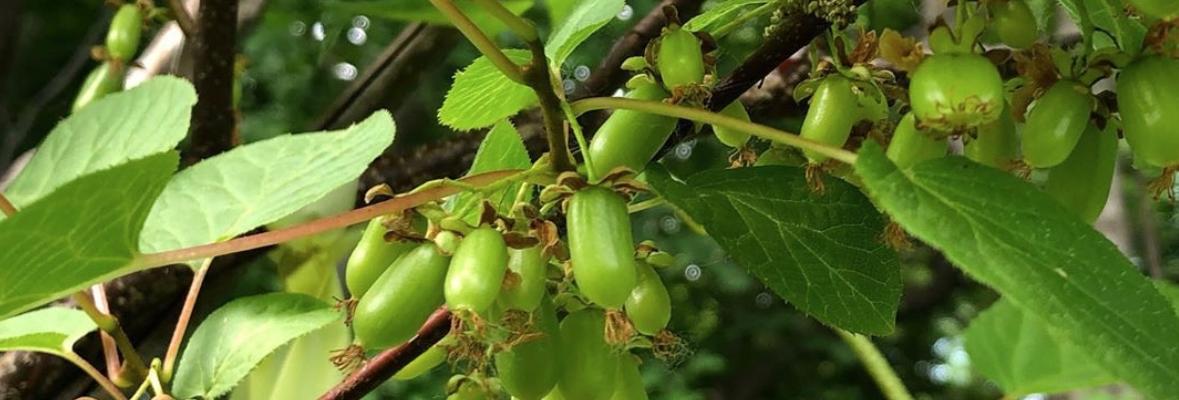
Maybe eventually the hardy kiwi of Massachusetts will become well integrated into that ecosystem. Maybe it will die out. We don't know. But, as long as we do not supply human needs from the lands already set aside for that purpose, then more and more land, including, eventually, that forest strewn with hardy kiwi, will continue to be stripped of both its natives and exotics, its natural state altogether, and will be turned into a factory farm or a monocultured, manicured forest.
I am now going to go check on my two hardy kiwis.
Thoughts? Let me know in the comments section.
Thursday, May 2, 2013
Specimen Spotlight: Borage
Borage (Borago officinalis)
Borage is often best known for its pretty blue flowers, and for good reason, too. However, as is common with most plants, borage can fill more roles than just visual appeal.
 |
| Borage - Source |
- It is included in the group of dry weather friendly plants, meaning that, once well established, it can hold its own against hot, dry days with little or no water. On top of that, unlike many desert plants that can take the heat but not the wet, borage happily continues on its merry way through long periods of precipitation.
- It has the benefit of being a nutrient accumulator. It will send down roots deep into the soil to find minerals and nutrients that are beyond the reach of other plants. Those minerals and nutrients are pulled up into the leaves. Later, when the leaves die and decompose at the ground's surface, those nutrients and minerals are made available to other plants. Borage is especially good at retrieving potassium and silicon, both of which are important to many plants.
- People are not the only ones who enjoy the blooms that borage produces. Insects, most especially bees, find the flowers to be a very attractive source of pollen and nectar.
- Interplanted with comfrey you receive a synergistic effect in providing mulch making and weed suppressing benefits. This comes, in part, from borage's indeterminate growth habit, meaning it does not have a standard height at which it stops growing. It is more likely to flop over parallel to the ground, just like indeterminate varieties of tomatoes, and start growing vertical branches. This technique, so to speak, accomplishes three things. First, this immediately shades more of the ground, inhibiting the ability of weeds to germinate and grow. Second, more of the plant is now in contact with the ground which hastens decomposition and improves mulch making when the plant dies. And third, this allows borage to spread seeds over a wider area - it is supposed to readily self-reseed. The following year many borage seedlings will sprout and grow, shading out weeds.
Borage also does well as a mulch maker due to its large, green, soft leaves, like comfrey, that shade the ground and provide quality mulch in a hurry. - In Jessi Bloom's book, Free-Range Chicken Gardens
- On that note, people typically do not care for the leaf fuzz, either. So, since the leaf is perfectly edible, the suggested way to eat them is to add them finely chopped into a salad. The leaves are said to have a flavor similar to cucumber. However, they are best eaten fresh, as they lose their flavor and color when dried.
- Peel, chop, and use the stems like celery.
- Some foods that mesh well with the texture and flavor of borage are green salads, most vegetables, salad dressings, pickles, cheese, fish, poultry, and iced beverages.
- Additionally, the flowers are reputed to be one of the few truly blue natural edible substances. They have a sweet taste, sometimes also having a bit of the cucumber flavor that the leaves have. As is typical with edible flowers, they are often used as a garnish or with desserts. And they can also be used to create an edible blue dye, which apparently turns pink when mixed with an acid.
- Borage has traditionally been grown not just to eat, but also as a medicinal herb. Jethro Kloss, in Back To Eden
, explains how borage can be used in the healing of a myriad of maladies. You can look at Wikipedia.org and Plants for a Future to learn more.
- Sometimes borage pretends to be a biennial and will not flower the first year. Be patient and encourage new seedlings by keeping the ground moist, especially through the use of mulch around the seedlings once they have begun to poke up.
- Garden Wisdom and Know-How
has the following bit of trivia:
"Borage has a reputation for invoking courage. In fact, ancient Celtic warriors preparing for battle drank wine flavored with borage to give them courage. They believed their fears would vanish and they would feel elated. (The effect was probably due to the wine, not the borage)" (pg. 258).
In days gone by, ladies would embroider borage flowers on handkerchiefs as 'favours' for knights in the joust, or to drop for soldiers to collect as they march off to war. - There are many plants that enjoy a friendly relationship with borage. Some of these include cucumber, tomato, squash, strawberry, and members of the cabbage family in general. It has been reported that most garden plants grow better and have better tasting produce when borage is grown as a companion plant with them.
- Besides promoting plant health, growth, and production, borage is also used to repel some pests. One common use is having borage and tomatoes together, which apparently deters moths whose larvae are the tomato hornworm.
Resources
- The Ultimate Guide to Permaculture by Nicole Faires
- Free-Range Chicken Gardens by Jessi Bloom
- Gaia's Garden by Toby Hemenway
- Back To Eden by Jethro Kloss
- Garden Wisdom and Know-How compiled by Judy Pray
- Carrots Love Tomatoes by Louise Riotte
- The Vegetable Gardener's Bible by Edward C. Smith
- Sepp Holzer's Permaculture by Sepp Holzer
- Plants for a Future, Plant Database: Borago officinalis
- Wikipedia.org: Borage
- USDA NRCS Plants Database: Borago officinalis
- Missouri Botanical Garden: Borago officinalis
- Dave's Garden, Plant Files: Borage. See this page's comments section.
- RHS Plant Selector: Borago officinalis


Tuesday, April 30, 2013
Perennial vs. Annual
I think that it is safe to say that when people think about food plants, the first examples that come to mind are typically going to be annuals. Some of the standard annuals are tomatoes, peppers, peas, beans, squash, carrots, etc. Most vegetable gardens are prepared and planted each year with the seeds of these and other annuals. Many front yards are replanted each spring with flowering annuals.
I must say that I am very much biased in favor of perennials. So what I am going to do is list out reasons and explanations as to why it is good to investigate perennials when looking for a plant to add to your yard. Then I will try to come up with rebuttals to some of the arguments that I have commonly heard against planting perennials.
I must say that I am very much biased in favor of perennials. So what I am going to do is list out reasons and explanations as to why it is good to investigate perennials when looking for a plant to add to your yard. Then I will try to come up with rebuttals to some of the arguments that I have commonly heard against planting perennials.
- Perennials require less maintenance over time - One of my college professors taught that it is good to work hard to be lazy. Perennials help me do this by allowing me to make sure that what I plant in that spot is what I want and where I like it, I add mulch, and then I leave it alone to grow. I notice it in the yard and I check in on it from time to time. And if it is a fruit-producing plant (my favorite kind!) I harvest the fruit when it is ripe. That is about all I do. Sometimes I need to add another layer of mulch, trim a few branches, or separate and replant (or give away) clumps. But even these things are done no more than once or twice a year. The only thing that requires regular attention is watering. And perennials that are well established need less water than annuals. Each year perennials increase the spread of their roots, enabling them to find pockets of water not available to shorter-rooted annuals. Also, as they are more or less permanent in their locations, a drip system, once setup, does not need to be moved, unlike a garden of annuals where the drip system must be rearranged each year.
- Perennials improve the soil - There are two ways that perennials help the soil. The first is that they do not need tilling. Tilling bares the soil, letting wind and rain erode it. Tilling also disrupts or even kills many of the organisms that allow nutrient exchange in the soil to happen. So perennials help prevent erosion and encourage the growth of nutrient-promoting soil organisms by eliminating tilling. The other way that perennials help improve the soil is by the decomposition of their roots and leaves. This biomass adds organic material to the soil, allowing it to better sustain life, as well as allowing it to better retain water for long term usage.
- Perennials add habitat - Because perennials are there year after year, all kinds of birds, bugs, and beasts find them as important locations for shelter and food. And when your yard increases in its diversity of life it gains greater balance and resilience. Each species provides multiple roles in an environment and many species often fulfill some of the same roles. This means if one species gets wiped out, the rest that were meeting that need can take of the slack. As I see it, as more species become involved in my garden, I gain that many more helpers to maintain it, which requires less from me. And it is possible because of the benefits provided by perennials.
- Perennials provide beneficial microclimates - Microclimates are areas in your yard or garden that, because of elements around them, have slightly different weather conditions. One spot is warmer and sunnier in the spring when the rest of the yard is still slumbering under snow. Another is shady and cool during the blistering heat of summer. A third is moist with green, growing plants when all around it are brown and desiccated plants. These are all examples of microclimates. Perennials can be used to help create microclimates like these to facilitate the growth of plants that would otherwise not grow and produce as well.
- Perennials fill multiple roles - As I mentioned in number three, many species fill multiple roles in an ecosystem. Perennials are no exception to that. Some roles that perennials fill can include: add , provide mulch, increase mineral and nutrient availability to other plants, supply food to people or animals, attract beneficial insects or other animals, be used as a medicinal herb, provide shade, block the wind, prevent erosion, and create materials used in basketry, woodworking, or other projects. And those are just some of the roles that perennials can fill. Each yard or garden has its own idiosyncrasies and have custom jobs that, if you are creative, you can find a perennial to manage for you.
Okay, there you have the list of reasons for making perennials a significant part of the yard and garden. Now, just to make sure that no one misunderstands, I love the produce that I get from annuals.To me there is nothing like a just-picked, backyard-grown, vine-ripened tomato. I suspect that I will always have annuals in my garden yard. But I have planted many, and will continue to add new, varieties of perennials. Now then, on to the rebuttals.
- There are no perennial varieties of __________ for temperate climates.
This is, in my opinion, an excellent reason to grow annuals. However, I think that even when growing annuals you should get seeds that are open-pollinated varieties, and heirloom types, if possible. I have done this with many types of standard garden vegetables and have basically allowed them to naturalize in my yard.
When a plant is open-pollinated it can be pollinated by insects and produce viable seeds that can be used the following year to grow more of the same type of plant. These can become "self reseeding", giving you what gardeners typically call "volunteers," plants that are coming up from seed left from last season's plants and without manual planting. Store-bought hybrid seeds or seedlings are not open-pollinated and the resulting seeds will not grow "true to form" - meaning that the offspring will be significantly different from the parent plant. In my garden yard, each year I get sunflowers, spinach, squash, pumpkin, tomatoes, and tomatillos growing without me doing anything at all. If I feel so inclined I can transplant them to a more preferred location. But I usually like to let nature decide where a plant will come up and how it will do in that spot.
Over time, the plants become adjusted to your area and your soil, making them more hardy and often better producers.
*Note: Some varieties are of the same or very similar species and will cross-pollinate. For example, I picked a very nice looking winter squash that looked a lot like a pumpkin. When I cut it open I found that it was apparently part pumpkin and part spaghetti squash. It was still totally edible, and fun to find, and I have eaten some that were far and away better than the previous generation. But some might be less inclined to have nature play mix-and-match with their annual veggies. To avoid this, either plant only one variety or species (you can typically find the species name on the seed packet), or separate the varieties as much as is feasible. - Some of those perennials taste bad/bitter/funny/strange.
Yes, some of them do. However, the same goes for some of the annuals, too. Each person has different preferences as to what is pleasing to the taste buds and what is not.
Another reason, some might call this an excuse, is that, due to the popularity of garden annuals, most annuals have had years and years of work done to come up with great tasting varieties, while many edible and promising perennials have been left in their wild or near-wild state which usually tends to have less sweet and more bitter or strong flavors.
A third possibility is that the grower is still learning about the best times and parts to harvest from a perennial. Many perennials have leaves that are more mild than spinach but that turn incredibly bitter when the flower emerges. Knowing which part to eat and when to harvest is key to getting the best flavors. - The yard is too small for a perennial.
One misconception that many people have is that the only perennial plants are trees and shrubs. There are lots and lots and lots of types of perennials, from the obvious trees down to even the lowly dandelion, which is truly one of my favorite yard plants. Naturally, the roles that you are trying to fill as well as the restrictions that apply will dictate what types of perennials you can introduce. But there are many types of perennial plants even those that have no yard at all can put some perennials in a window box or balcony pot.
I know that there are other reasons that are given for both adding perennials and for leaving them out. I highly recommend learning about perennial plants and determining which ones would benefit you and your yard or garden. I found a list of over two hundred landscaping perennials at the Better Homes and Gardens web site. Not all apply to our location, but it is fun to peruse the list and imagine what you could do with some of the selections that are included in the list.
See also:


What other reasons do you have or that you have heard for planting or not planting perennials?
Wednesday, April 24, 2013
Permaculture Plants for Utah County
The following text is the explanation, etc., but if you just want the good stuff, skip down to the List of Ten - Part I.
I searched on the internet to find a listing of plants that were especially good for Utah County. You know, a nice, comprehensive list of "permaculture-ready" plants that really like the conditions found here. Whether I was just looking in the wrong place or, more likely, such a list had not been created, I don't know.
At any rate, I decided to come up with my own list of the top twenty permaculture plants for Utah County. At first it was difficult to get beyond a small handful of plants. However, once I began to really put my mind to it, I found that twenty was way too small of a number. But could I really call them the "top" plants for permaculture purposes in this area if I started making a long list? Not so much, at least to my way of thinking.
So now I have figured out what I am going to do: I am creating a list of ten plants that have multiple uses and are known to grow in this area. Every time I come up with ten more plants I will post about them with links to the other lists of ten. Hopefully that makes sense. At any rate, eventually there should be a good amount of ideas for those that would like to increase diversity in their permaculture plot.
Just to make things clear, these plant lists do not indicate any kind of priority or placement. In other words, the plants are organized arbitrarily and where a plant shows up is not a means of showing importance or significance. Good enough? Moving on then…
Anyhow, without further ado, I present the first list of ten.
I searched on the internet to find a listing of plants that were especially good for Utah County. You know, a nice, comprehensive list of "permaculture-ready" plants that really like the conditions found here. Whether I was just looking in the wrong place or, more likely, such a list had not been created, I don't know.
At any rate, I decided to come up with my own list of the top twenty permaculture plants for Utah County. At first it was difficult to get beyond a small handful of plants. However, once I began to really put my mind to it, I found that twenty was way too small of a number. But could I really call them the "top" plants for permaculture purposes in this area if I started making a long list? Not so much, at least to my way of thinking.
So now I have figured out what I am going to do: I am creating a list of ten plants that have multiple uses and are known to grow in this area. Every time I come up with ten more plants I will post about them with links to the other lists of ten. Hopefully that makes sense. At any rate, eventually there should be a good amount of ideas for those that would like to increase diversity in their permaculture plot.
Just to make things clear, these plant lists do not indicate any kind of priority or placement. In other words, the plants are organized arbitrarily and where a plant shows up is not a means of showing importance or significance. Good enough? Moving on then…
Anyhow, without further ado, I present the first list of ten.
List of Ten - Part I
-
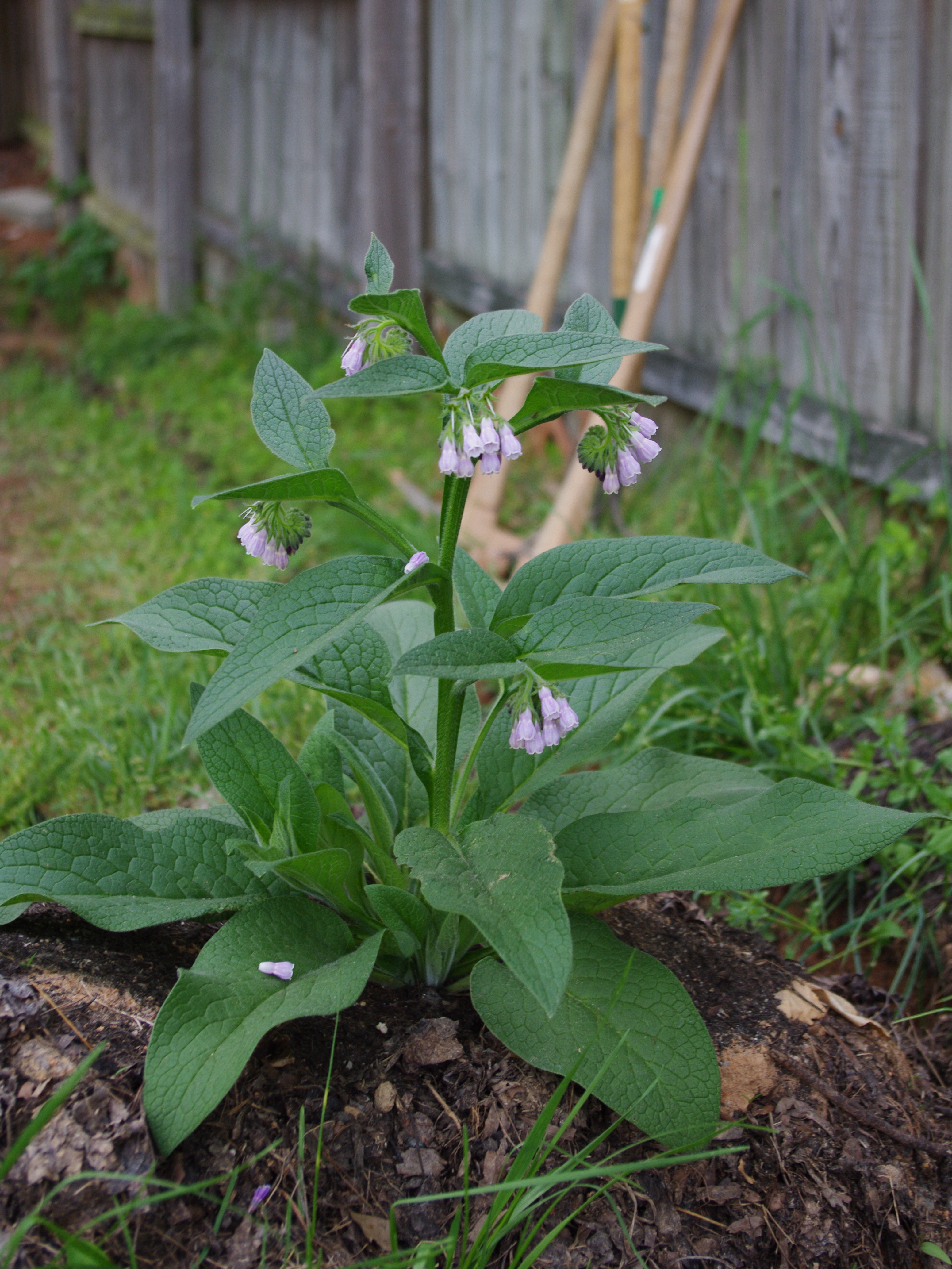
- Symphytum officinale (Comfrey)
→http://www.pfaf.org/user/Plant.aspx?LatinName=Symphytum+officinale
→Specimen Spotlight: Comfrey
• Nutrient accumulator
Comfrey - Full Size Photo - • Insectary
- • Medicinal
- • Mulch maker
- • Easy to propagate
- • Tolerates poor soil as well as high-nitrogen soil, such as on or near a manure pile
- • Dappled shade to full sun
- • Tolerates near drought to often wet, once established
- • Perennial - this should speak for itself; if you are curious about why perennial is important, read Eric Toensmeier's book Perennial Vegetables
- • Naturally occurring - it can be found scattered throughout Provo Canyon
• Flowers!
- Symphytum officinale (Comfrey)
-
- Amelanchier spp. (Saskatoon, Juneberry, Serviceberry)
→Specimen Spotlight: Serviceberry
→http://extension.usu.edu/range/Woody/utahserviceberry.htm
→http://www.pfaf.org/user/Plant.aspx?LatinName=Amelanchier+alnifolia
→http://sbe.umaine.edu/amelanchier/?page_id=134
• Naturally occurring - at least one species is native to this area and grows abundantly in Provo CanyonSaskatoon berries and
foliage - Source- • Fruit (this is always my top reason for growing something: can I eat it?) - Most people like the berries, although some species have sweeter fruit than others. Birds will eat the fruit, especially those that are still on the plant in late winter.
- • Drought tolerant, once established
- • Is not picky about soil type
- • Partial shade to full sun
- • Shrub - it can grow to the size of a small tree. It can be coppiced to provide mulch material.
• Blossoms!
- Amelanchier spp. (Saskatoon, Juneberry, Serviceberry)
-
- Taraxacum officinale (Dandelion)
→Specimen Spotlight: Dandelion
→http://www.wildmanstevebrill.com/Plants.Folder/Dandelion.html
• Insectary
Dandelion flower - Source - • Nutrient accumulator
- • Thrives on neglect
- • Shade to full sun
- • Edible - it is becoming a very popular salad green. Be sure to pick the leaves before the plant flowers, otherwise they tend to turn bitter. You can also eat the large taproot. Cook it like you would other root vegetables such as carrots, parsnips, or potatoes.
- • Perennial and self-reseeding
- • Medicinal - as is the case with most, if not all, nutrient accumulators. It has been theorized that the ability of these plants to gather hard-to-reach nutrients might have something to do with their medicinality.
- • Flowers! - okay, so dandelion flowers may not seem like much to look at, but little children love them!
- Taraxacum officinale (Dandelion)
-
- Vitis spp. (Grape)
→Specimen Spotlight: Grape
→http://pfaf.org/user/Plant.aspx?LatinName=Vitis+vinifera
• Vine - helps fill in the vine niche in the seven levels of a forest garden
Grapes! - Source - • Edible
- • Bird feed - birds especially like seedless varieties. In this area there enough grapes that the birds mostly ignore any grape that is not seedless while devouring those that are.
- • Medicinal
- • Climber - as a deciduous climbing vine, these plants do a great job of climbing and covering during the summer, which provides shade, and then dropping it leaves in the fall and allowing any winter sunshine available to shine through.
- • Basketry
- • Privacy fence - for those that want to make a chain-link fence a little less see-through, grape vines will vigorously grow to create an almost impenetrable covering
- Vitis spp. (Grape)
-
- Malus domestica (Apple)
→Specimen Spotlight: Apple
→http://pfaf.org/user/Plant.aspx?LatinName=Malus+domestica
• Edible
Malus domestica - Source - • Attracts wildlife - many animals, from birds to rodents to large mammals, like apples
- • Medicinal
- • Insectary - have you ever listened to an apple tree in bloom? It sounds quite similar to a bee hive!
- • Nutrient accumulator - stores potassium in its leaves
- • Dentrifice - eating an apple helps clean the teeth and gums
- • Wood - used both as a fuel and for woodworking
- • Habitat - adding a tree to a yard, especially if it is a standard-sized one, not a dwarf, will really increase the amount of creatures that can find food and shelter in that yard. And more creatures means better diversity, better balance, and the perks that each species provides just for being able to hang around.
• Blossoms!
- Malus domestica (Apple)
-
- Helianthus annuus (Sunflower)
→Specimen Spotlight: Sunflower - • Insectary

Field of sunflowers - Source - • Edible - you can eat them as microgreens, in addition to the well known sunflower seeds and the petals make nice additions to summer salads
- • Poles - my pole beans sometimes like sunflowers and sometimes do not, but I can always use last years sunflower "trunks" as teepee trellis poles without any problem
- • Self-reseeding
- • Bird seed - you don't need to do anything, the plant grows the food and then hangs it out for the birds to "harvest" at their convenience
- • Mulch - the leaves provide soft mulch and when the poles are no longer fit for use as trellises they can be chipped into short lengths or even small pieces and added to wherever some more mulch is needed or be included in a new hugelkultur mound
- • Medicinal
• Flowers!
- Helianthus annuus (Sunflower)
-
- Helianthus tuberosus (Sunchoke, Jerusalem artichoke)
→http://www.hort.purdue.edu/newcrop/duke_energy/Helianthus_tuberosus.html
→http://en.wikipedia.org/wiki/Jerusalem_artichoke
• Insectary
Sunchoke flowers - Full Size Photo - • Perennial - these are another type of sunflower, but they propagate via tuberous roots as well as by seed
- • Edible - the root tubers are a great food source, both raw and cooked. Also, just like sunflowers, the flower petals are especially nice in a salad.
- • Livestock feed - the leaves and stalks are very nutritious for grazing animals, and pigs enjoy digging and eating the tubers
• Flowers!
- Helianthus tuberosus (Sunchoke, Jerusalem artichoke)
-
- Raphanus sativus var. longipinnatus (Daikon radish)
→http://en.wikipedia.org/wiki/Daikon
→http://aggie-horticulture.tamu.edu/archives/parsons/publications/vegetabletravelers/radishes.html
• Insectary - when left to bolt, radishes, like the other members of the Brassica family, put up little yellow flowers that are appreciated by the local insects
Daikon - Source - • Soil improver - this type of radish grows a root that looks like a very large carrot, similar to a parsnip. Just leave the root in the ground to decompose, thereby adding a deep injection of organic matter to the soil.
- • Edible - many tons of this type of radish are grown in east Asia as a companion food to rice
- Raphanus sativus var. longipinnatus (Daikon radish)
-
- Trifolium spp. (Clover)
→http://en.wikipedia.org/wiki/Clover
Clover - Source
→http://www.pfaf.org/user/Plant.aspx?LatinName=Trifolium+repens - • Insectary - bees especially like clover
- • Nitrogen fixer
- • Edible - leaves, flowers, sprouted seeds, etc.
- • Chop-and-drop mulching/green manure
• Ground cover
• Medicinal
• Lawn friendly - for those places where a small lawn is appropriate this plant is good to throw in with the grass as it tolerates trampling
• Perennial
- Trifolium spp. (Clover)
-
- Chenopodium album (Lamb's quarters)
→http://en.wikipedia.org/wiki/Chenopodium_album
→http://www.pfaf.org/user/Plant.aspx?LatinName=Chenopodium+album
• Edible - leaves in salad, seeds can be used like a grain (this plant is a close relative of quinoa,
Lamb's quarters - Source
the seed of which is becoming more commonly available), and the flowering shoots can be eaten in a similar fashion to broccoli- • Naturalized - another plant that is considered a weed
- • Trap crop - this plant is prized by leaf miners and will attract them to it, freeing other plants from leaf miner predations
- • Companion - when allowed to grow near potatoes it stimulates their growth
• Dye - green
• Soap - the crushed roots can be used as a soap substitute
• Medicinal - has some mild medicinal properties
- Chenopodium album (Lamb's quarters)


Saturday, March 16, 2013
Planting a Polyculture
 |
| Photo by Pascale Amez on Unsplash |
First off, let's define polyculture. Toby Hemenway in Gaia's Garden
explains it like this:"To re-create or mimic the original niches of our now-domesticated plants, we can use a gardening technique called polyculture, a word hybridized from the Greek poly, meaning 'many,' and the Latin cultura, 'to tend or cultivate.' Polycultures are dynamic, self-organizing plant communities composed of several to many species.
Interplanting and companion planting are elementary forms of polycuture, which in its simplest form is simply growing many plants together. But in more sophisticated polycultures, the plants themselves tune their environment to the best conditions for their growth... By blending a carefully chosen but highly diverse assortment of varieties, we can create gardens in which plants nestle together in minimally competitive patterns, bolster each other with beneficial interactions, and shift their composition in ecological succession, all combining to provide a lengthy and varied harvest of food, blossoms, and habitat" (p. 179).
To sum that up, you plant a variety of plants together in the same area. In other words, instead of planting one block each of peas, leaf lettuce, and broccoli, you plant multiple varieties of peas, leaf lettuce, and broccoli together. Notice that I said multiple varieties of each plant species. This allows for a longer harvest time as some varieties grow quicker, others produce longer, etc. Also, these plants need to be mutually beneficial, meaning that they should help each other out. Think about how each plant grows. Are they tall or short? Do they have deep roots or shallow ones? Are they a bush variety or a climbing variety? By intermingling plants that have different growth habits, you allow them to grow together without competing for light, nutrients, and water. Returning to the peas, leaf lettuce, and broccoli from above, think about how each one grows. Leaf lettuce will help shade the ground and keep it cool for the peas and broccoli. Peas will climb up above the lettuce and broccoli while also providing nitrogen. And by the time the broccoli has grown large the days are hot, so it then provides cooling shade for the lettuce, helping to prevent it from bolting or turning bitter.
The peas, leaf lettuce, and broccoli example is just a simple one, although it outlines one point that I would like to emphasize. Most conventional gardening methods show the garden as being comprised of only two dimensions. But when working with polycultures, and permaculture landscaping in general, you should remember that there are actually four dimensions in a garden: in addition to the conventional two horizontal dimensions (ahead-behind and left-right), you also have the vertical dimension (up-down) and, the most often overlooked, time. Knowing what happens over time allows you to plan that into your polyculture. As time passes, plants grow larger. At the start, more plants can be grown in a smaller area without inhibiting their growth. As you harvest some, you allow room for adolescent plants to continue to grow without stressful competition. Continued harvesting permits an optimal amount of plants to reach their desired size. Many pea varieties are great for the spring but die out in the summer. Therefore, planting pole beans a couple of weeks or so after your peas will let the peas pop up quickly to grow and produce, and then be replaced in summer by pole beans which thrive in the summer heat.
The polyculture I just planted in my garden is a mix of the two examples found in Gaia's Garden
, with a few additions and changes just to shake things up. :-) Another difference is that, instead of waiting for the last frost date for my area, which is typically almost two months away, I use a cover to prevent hard freezes.This is meant to basically be my salad bar. So, to provide a good salad base with lots of variety, I planted arugula, mache, a few different mustard varieties, multiple types of leaf lettuce, romaine, and a couple types of head lettuce. After the main greens, I added radishes, chard, carrots, fennel, dill, coriander, marigold, pansies, calendula, and parsnips. Then I planted a few bush peas and some leeks well spread out so as not to crowd each other or the other plants. I also included red clover and alfalfa for ground cover, nutrient accumulation, and nitrogen fixation, since I happened to have some seeds laying around from growing sprouts. I also anticipate lamb's quarters - a "weed" in the genus Chenopodium which also includes quinoa and Good King Henry - to show up in any open spots, followed by purslane - a great vegetable source of omega-3 - in the summer, both of which are great additions to any salad.
In a few weeks, I will begin harvesting. I will start out doing thinning by harvesting. In the resulting gaps, I will add cabbage or broccoli seedlings that I have going in my mini-greenhouses. Eventually, I expect to switch to a cut-and-come-again method when the plants have been reduced to what can fit in the area I planted. In any spots that have opened up by that time, I will plant herbs, such as basil, and bush beans since they both welcome the heat of summer. One other thing to keep in mind is that, as the weather grows warmer, the cool-weather plants will have a tendency to bolt. This can be nice because the plants can naturalize by reseeding themselves. If you would rather not have their progeny popping up in the spring, be sure to speed up the harvest of these plants before they bolt so they will be consumed before they can reseed.
One of the polycultures found in Gaia's Garden
can be found at http://www.chelseagreen.com/content/start-a-polyculture-now-toss-a-salad-tomorrow/.See also:
http://www.permies.com/t/3648/permaculture/Ianto-Evans-Polyculture
http://www.veggiegardeningtips.com/surprising-lambs-quarters/
http://pfaf.org/user/Plant.aspx?LatinName=Chenopodium+album
Update: We are well into spring now, although it has been pretty cool which has allowed the living salad bar to continue to grow at a comfortable pace without going into panic mode and bolting. Here are a few pictures. The first two are in the early stages before much of anything was coming up in the non-sheltered section. It looks a little sparse. Not to worry, though! As you can see in the third photo, the plants did come up and continued to sprout and grow (and get eaten :-) ).
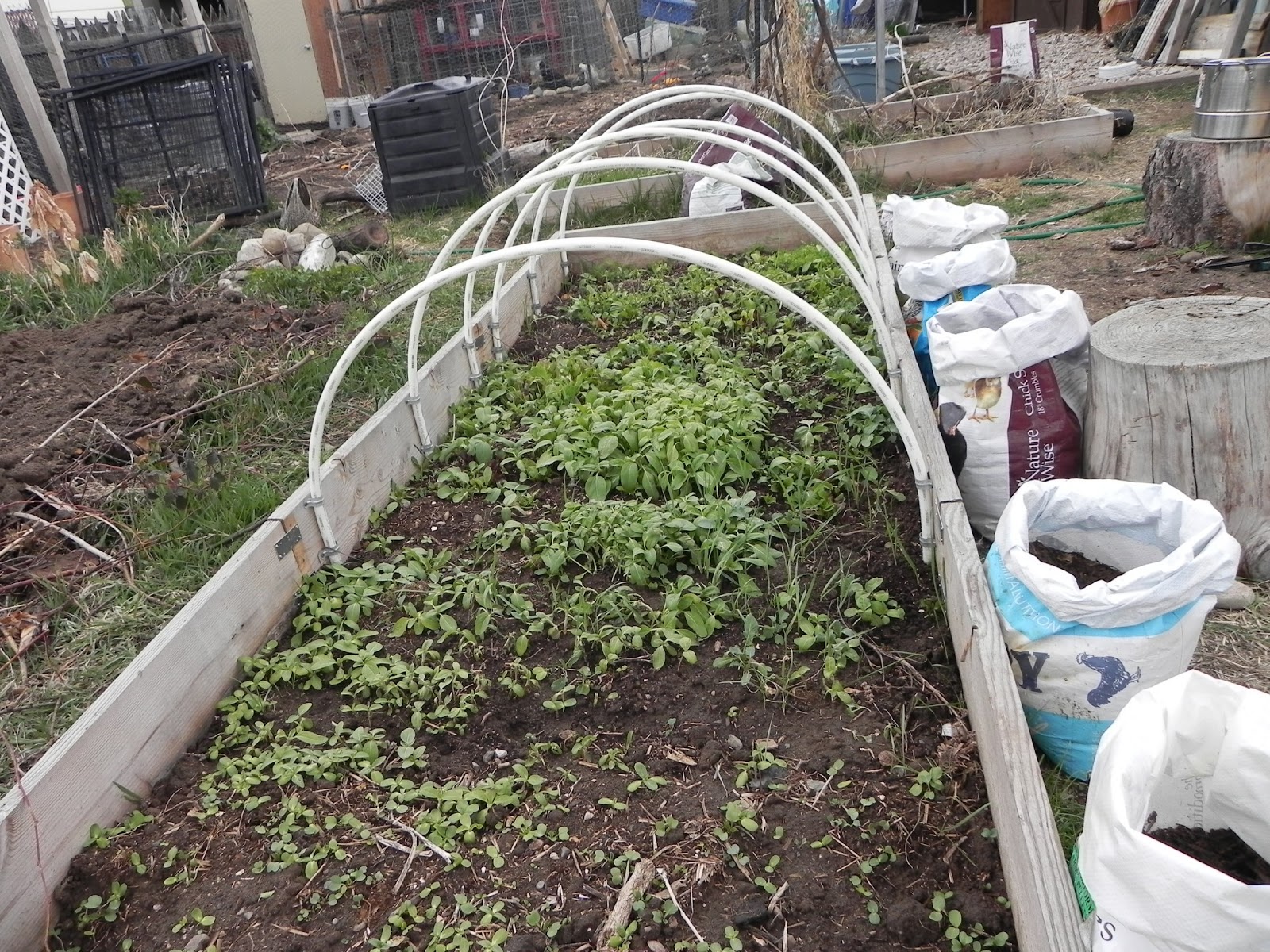
This is when the plants were still getting started. The bare-looking patch was planted a couple of weeks after the area under the hoops and had not yet done much in the way of growing.

From this angle, you can see groups of plants surrounded by open soil. Part of this is due to letting children help with planting. This was also caused by apparently huge amounts of sunflower seeds dropping onto this bed in the fall and taking advantage of the cover early in the spring to get a head start on growing. Most of the sunflower sprouts have been pulled and used as animal fodder so that Lettuce & Co. can get the light necessary for growth.

This is a more recent picture. You can see how the plants are really filling out the bed. With the exception of sunflower sprouts and bindweed (wild morning glory), which are used as animal fodder, everything else gets eaten by people, including the lamb's quarters and prickly lettuce. The radishes need continual thinning, but, as there are multiple radish lovers in my home, this is not a problem.

Here is what it looks like today. We just went through a few days of rain, so nothing has been picked for a bit. Even the aggressive sunflowers that escaped culling are hard-pressed to keep up with everything. You cannot even tell that, with the exception of the past three days, we have heavily harvested this patch.

Here it is from the other end. Even the later plantings are growing fast and furious. Most of the weeds have been squeezed out except for in a few niches, with the noticeable exception of bindweed. It just sends up a flag above the other plants to make sure it is getting enough sun. It is definitely a difficult plant.

And here is the overview. There is a somewhat bare section in the middle where one end of the plastic that was draped over the hoops was weighted down. A couple of tomato plants have taken up residence there to keep the ground covered and make use of good soil.
Nothing special was really done with this bed. It was planted early and this spring has been quite exceptional for cool-weather plants.
Subscribe to:
Posts (Atom)